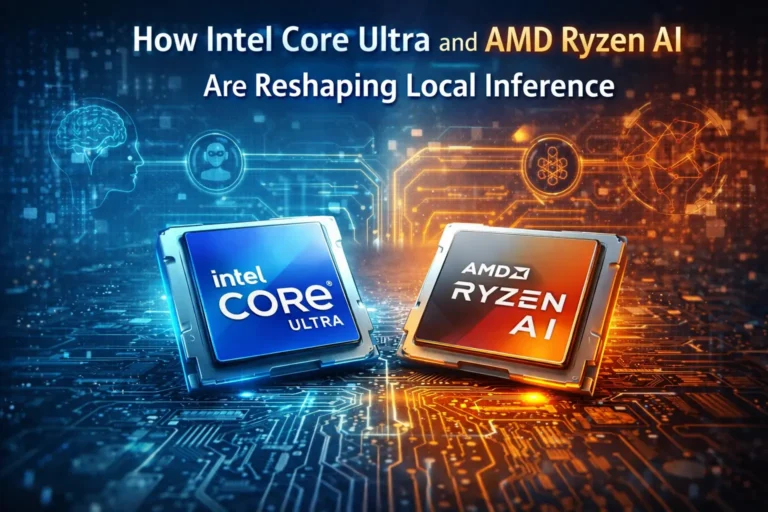
How Intel Core Ultra and AMD Ryzen AI Are Reshaping Local Inference
Table of Contents
Local AI Inference Overview
The rapid change of Artificial Intelligence from a technology that drives business functions to one that does so using Local Inference (running AI Models on devices) instead of relying on cloud-based computing systems has many components. Currently, AI workloads can be run locally using the latest Intel Core Ultra processors and AMD Ryzen AI processors, allowing businesses to improve operational efficiency and create improvements with real-time data processing.
Local inference provides faster processing, eliminates data privacy concerns, and decreases dependence on internet connections for businesses in the UAE. The adoption of these New Technologies will allow organizations in the UAE to automate daily tasks, create enhanced workflows, and deploy real-time data processing for improved operational efficiency.
Businesses can now run their AI workloads on Commercial devices such as Laptops and Workstations with next generation processors through Janasys.
Two major technologies are enabling the drive toward Local Inference:
1. Intel Core Ultra Processors
Intel’s new line of processors, the Intel Core Ultra processors (with integrated Neural Processing Units), have built in capabilities to accelerate AI applications through dedicated NPU integrated into the processor. These processors provide the following capabilities to devices running Intel Core Ultra Processors.
Integrated Neural Processing Unit (NPU)
CPU / NPU Performance efficiency
Improved CPU / NPU performance for AI Workloads
Optimized Hybrid Work Environments
The Intel Core Ultra Processors provide devices the ability to perform AI tasks in Real Time such as Transcribing Audio; Processing Images; and Performing Predictive Analytics using Local Inference.
2. AMD Ryzen AI Processors
AMD Ryzen AI Processors have specialized AI engines that perform local processing.
Major Features of AMD Ryzen AI Processors:
AI acceleration hardware
High-performance multi-core architecture
Energy-efficient computing
Ability to support advanced machine learning applications
Because they allow companies to run AI applications directly at the endpoint without significant reliance on the cloud, AMD Ryzen AI processors enable local inference on devices being deployed by organizations through Janasys.
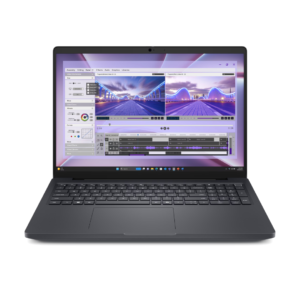
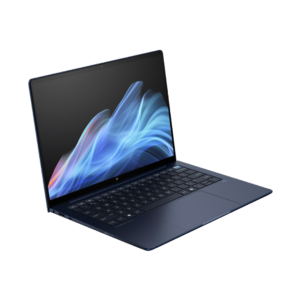
The HP EliteBook eight G1i, 14-inch and 16-inch, will deliver performance and scalability for business users who use the device for AI-enabled applications.
HP EliteBook Eight G1i Key Features:
Intel Core Ultra processors
DDR5 memory
enterprise security features
optimized for multitasking and AI workloads
These devices are ideal for professionals working in AI.
Why Local AI Inference Is Important for UAE Businesses
TheUAElocal AI inferencemarketiscriticalforbusinesses in Dubai and the Middle East that are increasingly using AI to compete. By implementing AI-capable devices through Janasys, businesses can easilycreatehighly efficient and very secure, AI-enabled environments.