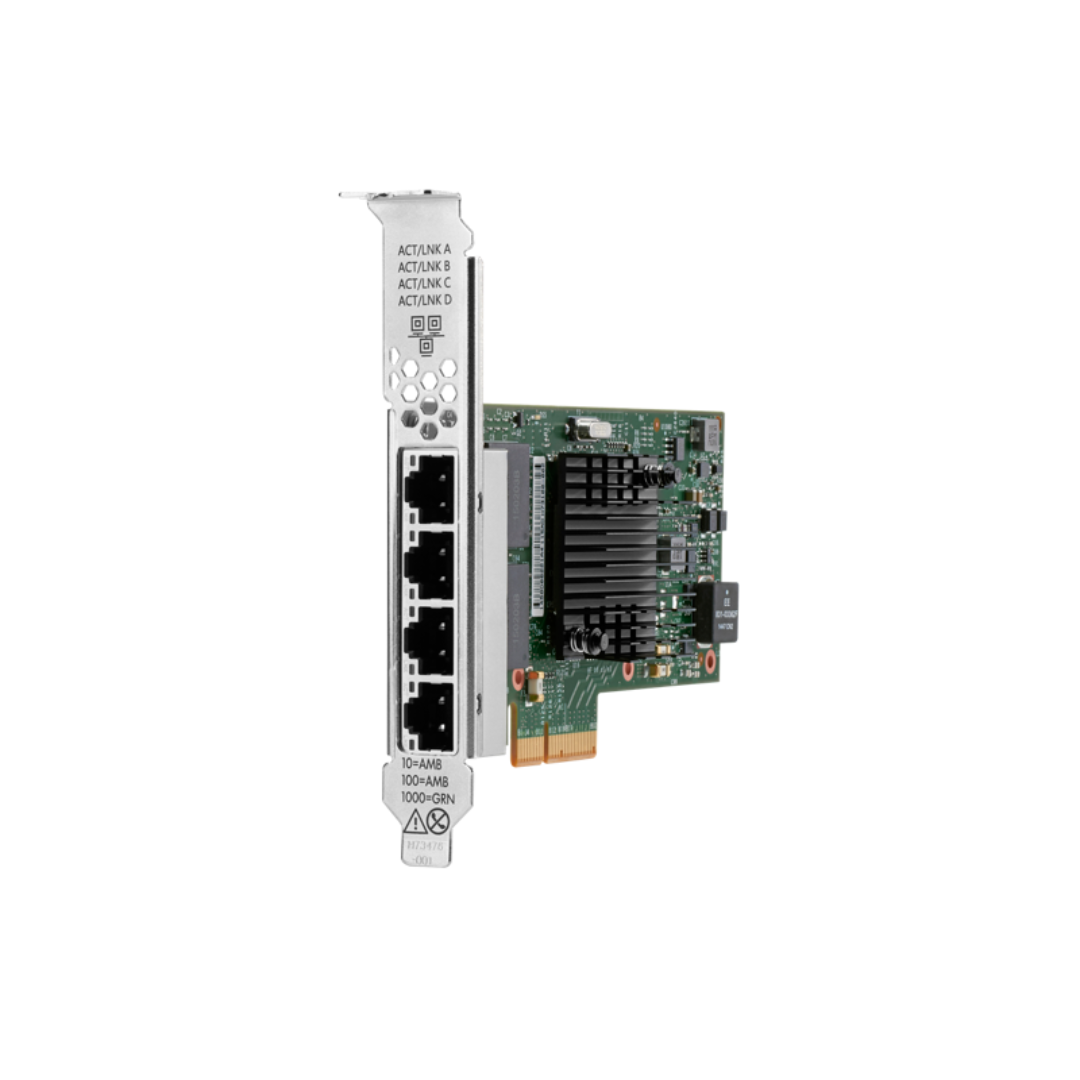
Providing 1Gbit Network Connectivity For HPE Servers And Networked Solutions The HPE 1 GbE 4 Port BASE-T Adapter enables you to connect both HPE server systems and your entire enterprise network via Ethernet, to achieve the fastest possible 1Gbit/s speed for your enterprise applications.
Your server or complete network solution will be provided with four RJ45-based 1Gbit Ethernet ports (enabled by the HPE Broadcom BCM5719 chipset) for greater bandwidth, redundancy, and flexibility, as well as to support your enterprise applications with advanced networking features, such as VLAN tagging, PXE boot support, NIC teaming, and load balancing.
The HPE 1 GbE 4 Port BASE-T Adapter features a PCIe 2.1 x4 interface and is designed with a low power design for supporting small to medium size businesses, virtual machine (VM) host systems, or servers requiring stable and scalable network connectivity.
This adapter is designed to fit in the tight confines of a data center/server environment, while providing the level of reliability needed to be MLO(Medium Line Operations) capable in a high-demand environment.
Technical Information:
Product: HPE 1 GbE 4 Port BASE-T Adapter
Part Number – P51178-B21
Ports 4 X 1GbE BASE-T RJ-45 Ports
Chipset: Broadcom BCM5719
Interface PCIe 2.1 x4
Speed 1GbE GIGABIT ALT .1Gbit/sec
Network Features PXE Boot, VLAN Tagging, NIC Teaming, Load Balancing
Low Power Design
Compatible Systems HPE Servers and Other Enterprise Systems
Use: Server Networking and Virtualization
Advantages:
Quad Port GIGABIT Ethernet Connections
Broadcom BCM5719 Chipset Provides Reliability
Allows Network Redundancy/load Balancing
Improved Management of Networks Using VLAN Tagging
PXE Boot Enabled