SAS vs SATA Storage UAE | Which is Better for Business?
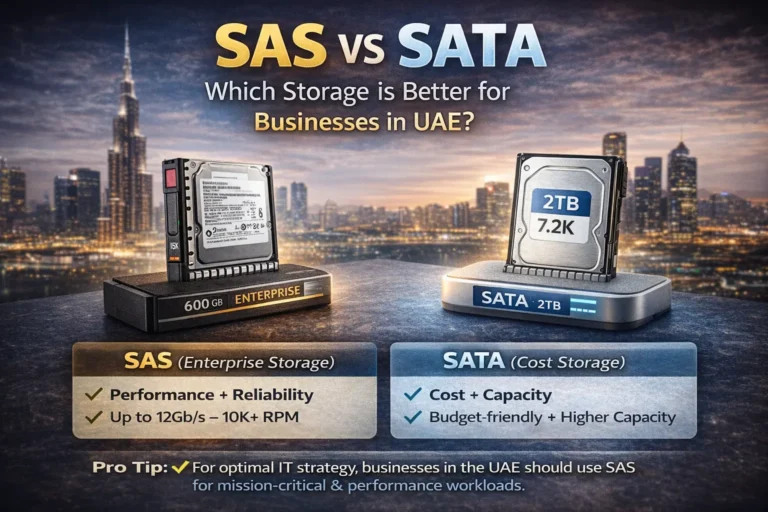
SAS vs SATA: Which Storage is Better for Businesses in UAE?
Table of Contents
Selecting the appropriate storage option is essential for businesses relying on data performance, reliability and scalability. Companies in the UAE work within an ever-changing digital environment where they rely heavily on driving server performance and operating efficiency, and therefore need to evaluate whether a SAS (Serial Attached SCSI) or SATA (Serial ATA) drive will help to accelerate their server’s performance and increase the efficiency of their overall operations.
By understanding the differences between these storage technologies, it should be much easier for businesses to make informed decisions based on the requirements of their workload.
What is SAS storage?
SAS storage is an engineering-grade data storage solution that is common in very high-performance environments such as servers and data centres.
The Benefits of SAS storage:
Faster data transfer rates
Greater reliability and durability
Designed for 24/7/365 operations
Greater performance for databases and virtualisation
SAS drives are predominantly used in enterprise-type IT infrastructure but are crucial to providing the required levels of performance and up-time.
What is SATA storage?
SATA is used primarily in desktop computers and lower-end storage devices and is much less expensive than SAS; however, it is not recommended for use in shop environments with higher workload intensities.
The Benefits of SATA storage:
Cost-effective storage solution
Appropriate for basic storage needs
Backup storage or archival storage
Lower power consumption
SAS vs SATA: Key Differences
Feature
SAS
SATA
Performance
High (10K/15K RPM)
Moderate (5.4K/7.2K RPM)
Reliability
Enterprise-grade
Standard
Use Case
Servers, databases
Backup, storage
Cost
Higher
Lower
Workload
24/7 operations
Light workloads
What Is the Best Storage Solution for UAE Businesses?
There is no specific answer to this, because it will depend on your company’s requirements:
Use SAS Storage to:
Maintain a server or data centre
Process large amounts of data at high speed
Have minimal downtime and ensure that services are available when required
Maintain a virtualised environment and/or database
Use SATA Storage to:
Use more affordable mass storage
Store copies (backups) of data or create archives
Have a lower intensity of workloads
When discussing the benefits to a business when selecting between SAS and SATA storage devices, the selection process should be made based on the required needs of a company rather than just the cost of the device used in a company. SAS drives are the preferred storage devices for supporting performance and reliability as well as for supporting enterprise workload requirements over SATA storage devices.
The main differences between SAS and SATA arethat SAS has higher speeds and reliability than SATA andthereforeSASismoreexpensivethanSATAbutprovidesbetterperformancethanSATA.